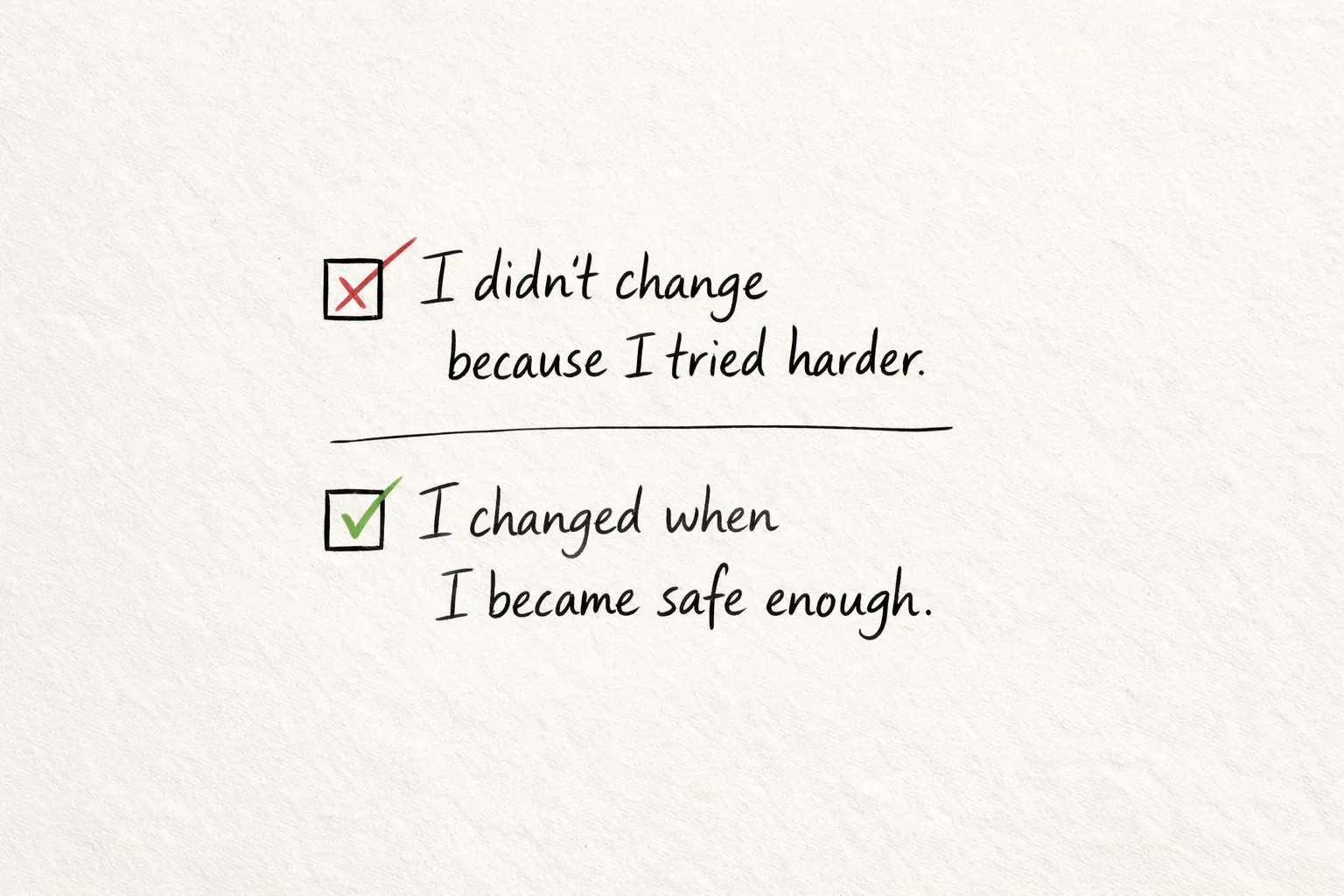
What it took to become safe enough to change
One year of hives. One year of freedom. Both at once.
I learned early that the best way to survive was to become whatever the room needed me to be.
I lived in an abusive household for most of my life. Survival shaped everything I became before I ever had the chance to choose. I had no real sense of agency or long horizon, only coping mechanisms that worked well enough to get me through the days.
Eventually, that stopped being sustainable.
I reached a point where my system was so stretched that something had to give. Therapy came first, but as a last resort. A month later, I made the decision to move out. It wasn't clean or empowering, it was terrifying. I knew there would be backlash, consequences, and loss. I did it anyway. It was the first time I truly held uncertainty and fear without suppressing it or spiralling.
Leaving didn't immediately feel like healing. My body was finally safe enough to fall apart, even at just the sight of imminent escape. Three days before my move-in date, hives appeared. Head to toe. Constant swelling. Unbearable itching. Every day, for a year. Trauma has a way of catching up once the threat is gone.
And yet, at the same time, I was experiencing something I'd never had before: freedom.
I was living alone in a space that was mine. I had a beautiful flat. I socialised. I traveled. I adopted the sweetest orange cat.
For about a year and a half, I lived in two parallel realities:
Grief and Relief.
Exhaustion and Delight.
I learned how to hold both without needing to resolve the contradiction.
Slowly, my system adjusted. Safety stopped feeling temporary. My body began to trust that this wasn't a pause before the next crisis. And that's when the deeper work started.
With more psychological space, I began questioning the structures that had shaped me. I returned to my faith, wanting to understand it on my own terms. What followed was a full deconstruction. Letting go of belief systems that had justified endurance over dignity changed something fundamental in me.
I realised I didn't owe my proximity to anyone who harmed me. Even if they were family.
Going no contact with my parents had nothing to do with rebellion or avoidance. It was an act of self-sovereignty. The same was true when I ended a long, on-and-off relationship where my needs were consistently unmet. And later, when I walked away from a four-year friendship after recognising years of subtle resentment and erosion.
Each ending clarified something: safety wasn't just about where I lived. It was about what I allowed to stay in my life.
As that clarity grew, my attention turned inward. I started studying my psychology, my identity, how the brain adapts. I began meditating. I started creating again, writing, building, expressing parts of myself that had been dormant for years.
I changed my last name to one I chose for myself; I started a business built on my own terms. These were the first things I ever grew in soil that wasn't toxic. Acts of self-definition that my nervous system finally had the bandwidth to support.
This change wasn't the cinematic transformation I once expected. It was structural, quieter, accumulative. I stopped living in the 'meantime', waiting for the crisis I'd learned to anticipate. I started living in the 'now.' I can hold a long horizon now. I can make a promise to myself and trust myself to keep it.
My real life began the moment I became safe enough to let it.