Premory builds cinematic rehearsal scenes around your likeness. Your face, your voice, the room you're walking into. So your body learns what your mind already knows. For the event ahead, or for every high-stakes moment after it.
| Mental Rehearsal | Notes & Frameworks | Mock Sessions | Generic VR | Premory | |
|---|---|---|---|---|---|
| See yourself performing at your best | Yes | No | No | No | Yes |
| Trains the body, not just the mind | Partly | No | No | Partly | Yes |
| Adapts to your specific fear points | Partly | No | Partly | No | Yes |
| Builds a felt sense of "I've done this before" | Weak | Partly | Partly | Yes | Yes |
| Compounds into identity-level change | No | No | No | No | Yes |
| Produces a tangible asset you keep | No | No | No | No | Yes |
The question isn't "what do you want to say in the room." It's "what does your body do when the stakes go up." That distinction is where Premory starts, and it's why everything that follows actually sticks.
Every scene is built with your likeness from first and third person perspective, your own voice for internal narration, your own somatic cues — heartbeat, muscle tension, breathing, ambient sound. It's not a visualisation exercise. It's a full cinematic experience designed around how your nervous system processes pressure.
Nobody else does this. Not VR companies. Not coaches. Not visualisation apps. This is the only personalised, self-referential rehearsal experience that exists.
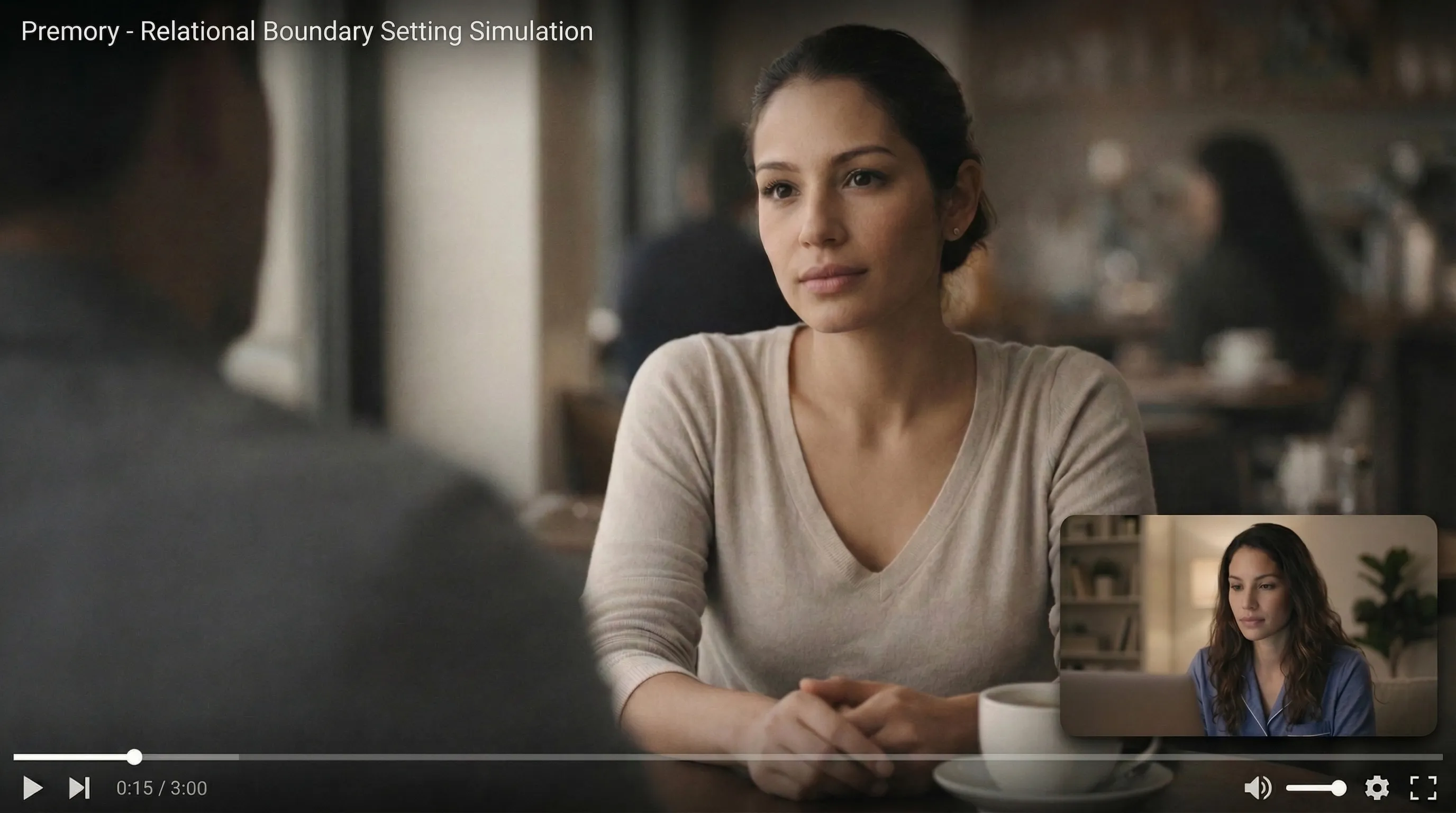
You have one specific high-stakes situation ahead. We prepare your nervous system for that room, that audience, that moment.
Four sessions. One bespoke cinematic scene. Built around the event ahead.
It's not about one situation. It's the same response showing up in every high-stakes situation. We change the underlying prediction so you show up differently everywhere.
Eight sessions. Two bespoke cinematic scenes. Identity-level work grounded in memory reconsolidation.
The tightness, the shallow breathing, the voice shift. Clients report noticeably less physical reactivity in the situations that used to activate them.
When activation does show up, it doesn't run the show. You catch it earlier, settle faster, and stay present instead of defaulting to old patterns.
More options in the moment. Holding a pause instead of rushing to fill silence. Speaking with authority instead of over-explaining. Choosing a response instead of being hijacked by one.
Your brain doesn't passively receive reality. It predicts it. When an alternative response gains enough familiarity through structured rehearsal, your system starts treating it as the default.
The brain processes vivid visual experience using many of the same neural pathways as lived experience. A well-designed scene can produce nervous system responses functionally similar to real encounters.
Under specific conditions, existing responses can be updated with new information. Premory's protocol is designed around this mechanism.
Your brain encodes information tied to "me" more deeply than anything else. When the scene is yours, your nervous system processes it as personal evidence, not abstract instruction.
CEO & Founder, Premory · Identity Architect · Learning Experience Designer
Behavioural learning designer specialising in how change stabilises under pressure. Five years building learning systems that map how skills embed through repetition, feedback loops, and structured exposure rather than just insight.
Before this was professional inquiry, it was personal necessity.
Premory exists at the intersection of cognitive science and applied design. It's built from a single question: why do some changes integrate into identity while others collapse the moment stress returns?
Premory is built for senior professionals facing high-stakes moments — board presentations, keynote speeches, partnership negotiations, high-visibility pitches, senior interviews, and high-pressure client meetings. It also works for deeper patterns: recurring confidence blocks, leadership identity shifts, and self-advocacy challenges. Anything where the stakes are high and how you show up matters as much as what you say.
Visualisation is limited by what you can already imagine, which is constrained by your existing patterns. That's why mental rehearsal often just rehearses the anxiety. Premory externalises the experience. You watch a scene generated outside your current predictions, not filtered through them.
No. Premory scenes are video-based. You watch them on any screen. No headset, no app.
Premory is not therapy, counselling, or clinical treatment. It's a structured rehearsal and integration process informed by neuroscience research. It can work alongside therapy but doesn't replace professional mental health support.
The Moment runs across four sessions — a deep intake, scene production collaboration, a guided viewing session once your scene is ready, and a post-event debrief. The entire process is designed to complete before your real event arrives. The Pattern runs over eight sessions and works on a longer timeline.
They represent two different decisions, not two sizes of the same thing. The Moment prepares you for one high-stakes situation — a specific event with a date on the calendar. The Pattern changes how you show up in every high-stakes situation — it's for when you've recognised that the same response keeps appearing regardless of the room, and you're ready to change the underlying prediction. The discovery call is where we figure out which decision fits where you are.
The opposite. Premory is designed for people who already have the awareness, the frameworks, and the self-knowledge. This is for when understanding isn't the bottleneck. It's designed for the gap between knowing and being.
Not ready for a call? Take the free 5-minute diagnostic — eight questions about your patterns, with a personalised report delivered to your inbox.
Let's make sure you're ready.
A 30-minute conversation to understand your situation and figure out the right approach.